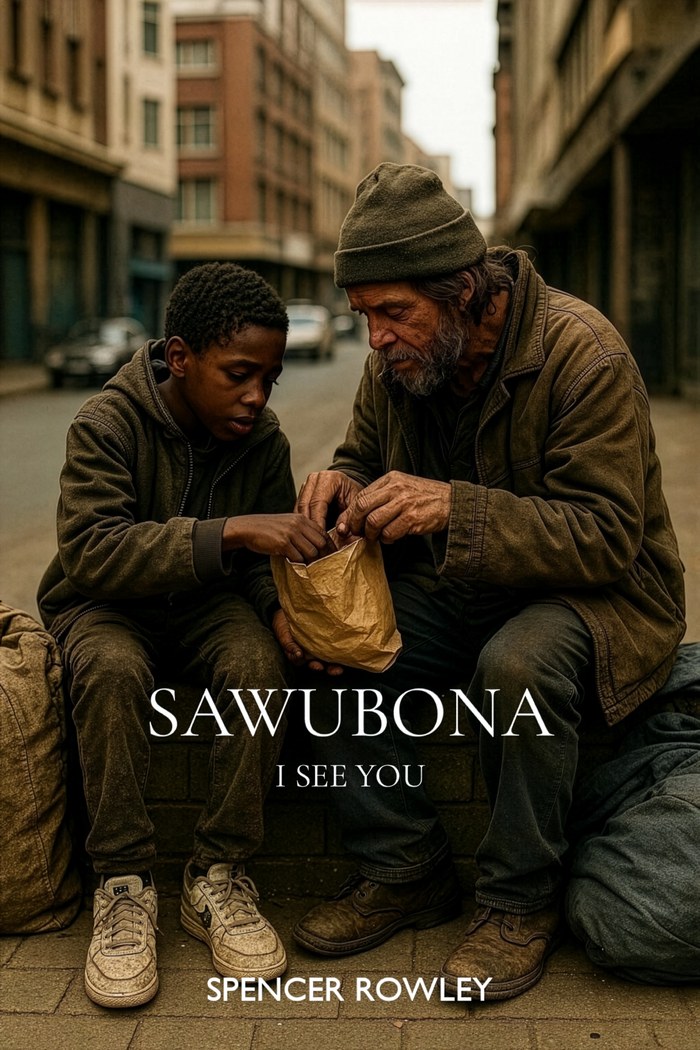
A Novel · Spencer Rowley
Sawubona
I see you.Zulu — a greeting that affirms another's existence
In a city of four million people, two of them are invisible. This is the story of how they came to see each other.
In a city of four million people, two of them are invisible. This is the story of how they came to see each other.
Set in the streets, parks and derelict corners of Johannesburg, Sawubona is a novel about being seen.
Robert Harrison once had a bakery, a wife, and a daughter — a whole life. Now he sleeps in a roofless room in the industrial south of the city, a homeless man holding himself together with routine, small dignities, and the daily effort of staying sober. His grown daughter passes him in the street and looks away.
Sipho is fourteen, sleeping rough behind a wall on the eastern edge of the city — hungry, watchful, surviving one day at a time alongside his friend Bongani.
When their paths cross on a Johannesburg pavement — a glance held a moment too long — something passes between them. Over the weeks that follow, an ageing white beggar and a young black boy build an unlikely friendship in a city that has rendered them both invisible, and discover that the smallest things — a pair of worn shoes, a paper bag of bread, a single word — can change the course of a life.
It is a story of grief and addiction and the slow, unglamorous work of redemption; of fathers and daughters; and of the kind of friendship that will fight to protect your shoes.
The man had been sitting in the late afternoon sun reading his book. He had chosen the bench by the south wall, where the sun reached in at just the right angle. There was a logic to such things. The book was a paperback gone soft with handling, the cover long lost, the spine held together with tape; he had read it fully twice now and would read it again.
He ran a hand through his greying hair, then picked up his peaked cap. As was his habit, his thumb passed once over the faded Harrison's logo above the brim. He settled it on his head and, leaving the relative quiet of the park, he began the walk home, turning west, where the sky above the rooftops had broken into long bars of orange and grey.
"Oh, no, Dad!" she exclaimed. "Not now, please!" She looked towards the man shuffling along the pavement, wearing an overcoat despite the heat, his eyes down as he did his best to avoid the people bustling past him. He lifted his head as Julie's car reached him, and for a moment their eyes locked.
The man paused and turned to watch the car go by. Tears formed in his grey-blue eyes as he reached into his grubby overcoat and pulled from his pocket a small, carved wooden heart. He fingered it gently. "Hello Jules," he murmured. He thought, as he often did, how strange it was that a man could be surrounded by so many people and still feel completely alone.
Sipho slowed a little as they drew closer. The man looked back at him with piercing eyes, and for no more than a moment they held each other's gaze. The man did not smile. He did not nod. He simply looked at Sipho, and Sipho looked at him, and then the man was past and walking on, and after a little while he was gone among the others on the pavement behind them.
Turning the corner into Pritchard Street, Sipho did not look back, but he walked on with the strange feeling that he had been seen.
Two free short stories — Sipho, from the world of Sawubona, and 10 Hours, a standalone tale told with the same close attention. They cost nothing — sign up and they're yours.
Sipho was fourteen when this story found him — but he had a life before Robert: a mother, a father, a classroom in Soweto, and the day everything changed. A free story about the boy before the bag of bread. If Sawubona stayed with you, this is where it begins.
Get the story Free Short StoryA free short story set in a Nottingham chip shop: ten hours of a Friday-night shift, and a voicemail from home that Robyn can't bring herself to play. The same close attention to being seen that runs through Sawubona.
Get the storySawubona is set in Johannesburg and told in the languages of that city. Most words carry their meaning in context — but here are a few you'll meet along the way.
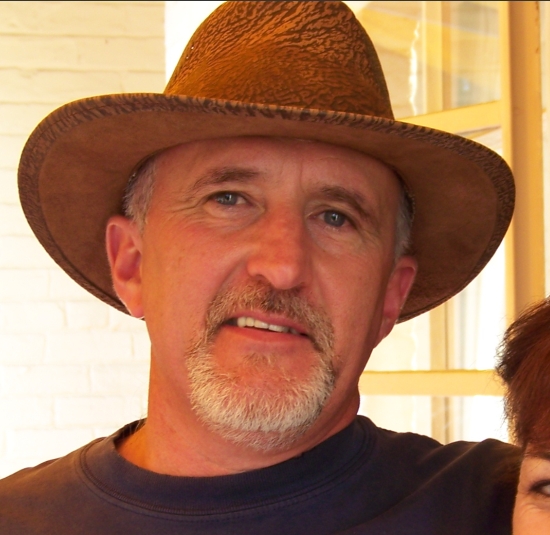
Born in Rhodesia and shaped by thirty-three years in South Africa, Spencer Rowley has been a soldier, a policeman, an IT consultant, an artist, and a musician. He brings to his writing the attention of someone who has inhabited many different kinds of life and writes from all those experiences. He now lives in Nottingham, England.